Introduction: A Historic Milestone for Energy Storage
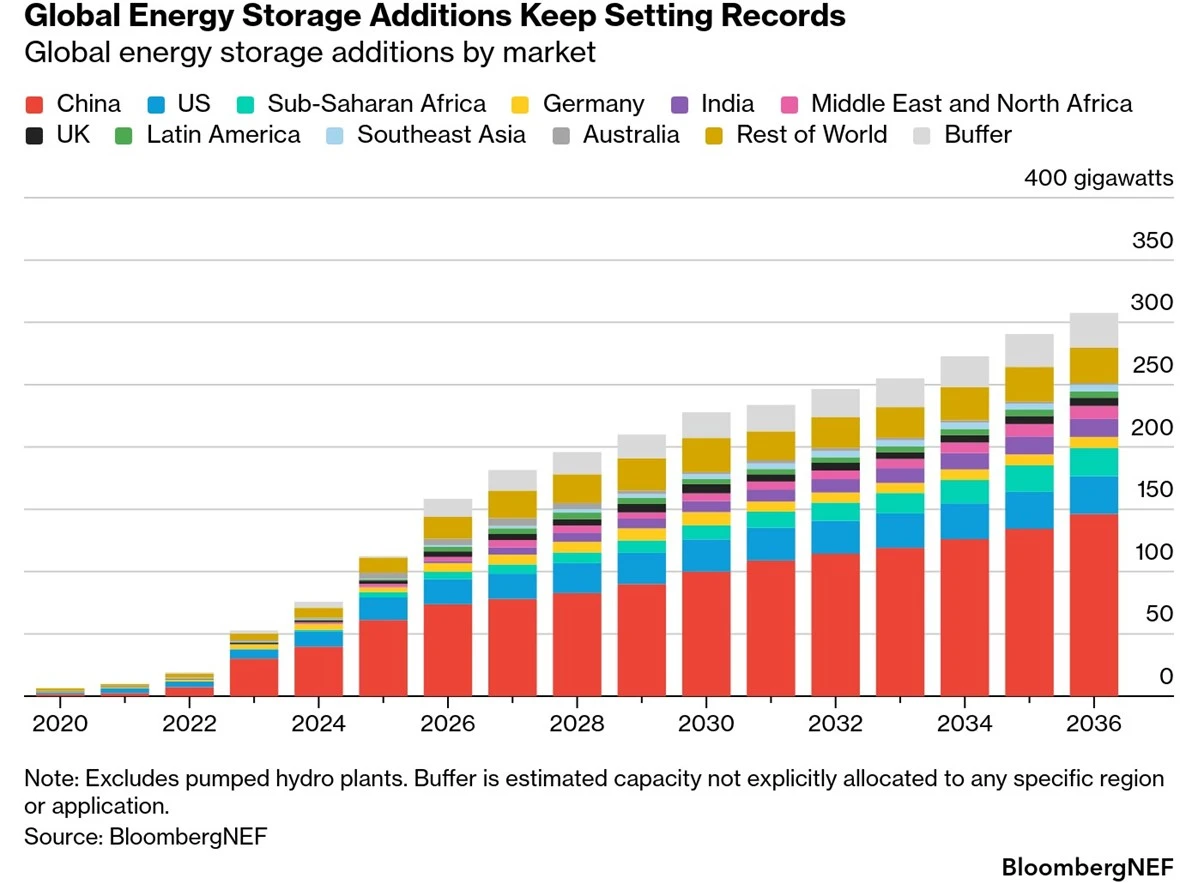
Energy storage has officially entered a new era of unprecedented growth, surpassing 100 gigawatts (GW) of annual additions for the first time in 2025. According to BloombergNEF's latest market outlook, global deployment reached 112 GW last year—an impressive 48% increase from 2024—with 307 gigawatt-hours (GWh) of batteries installed worldwide. This milestone marks a critical turning point, as energy storage transitions from a niche technology to a core component of global energy infrastructure, outpacing even wind and solar growth rates in its ascent.
🚀 The Explosive Growth Trajectory: Faster Than Wind and Solar
What makes this achievement truly remarkable is the speed of growth. It took energy storage just four years to scale from 10 GW to over 100 GW of annual additions, compared to eight years for solar and 15 years for wind. This acceleration reflects:
Rapid cost reductions in battery technologies
Increased renewables penetration requiring storage solutions
Policy mandates and co-location requirements
Emerging high-demand applications like data centers and EV charging
By 2026, BloombergNEF forecasts global energy storage additions will reach 158 GW, growing to 308 GW by 2036. The gap between solar and storage deployments is also narrowing dramatically: in 2025, for every 6 MW of solar installed, 1 MW of batteries was added—compared to 56:1 ratio in 2016. This trend is set to continue, with the ratio expected to reach 4:1 in 2026.
🌍 Global Market Dominance: China Leads, While Others Accelerate
The global energy storage landscape is dominated by China, which accounted for 54% of 2025 additions. The United States follows with a 16% market share, while Australia saw deployments nearly sixfold from 2024 due to favorable power market conditions and new residential storage subsidies. Saudi Arabia has also emerged as a key growth market as Chinese suppliers expand into the region.
This geographic diversification highlights the global recognition of energy storage as essential for:
Grid stability and reliability
Maximizing renewable energy utilization
Reducing reliance on fossil fuels during peak demand
Enhancing energy security in volatile geopolitical environments
⚡ The Iran War's Limited Impact: Opportunities Amid Uncertainty
Despite global geopolitical tensions, the direct impact of the Iran war on energy storage markets has been surprisingly limited—primarily due to China's dominance in battery supply chains. However, the conflict has created both challenges and opportunities:
Potential Benefits:
Higher intraday power spreads from soaring fossil fuel prices improve energy storage revenues in competitive markets
Increased retail electricity prices may drive more households and businesses to adopt rooftop solar + battery systems (similar to Europe post-Ukraine invasion)
Potential Challenges:
Rising oil prices could increase shipping and manufacturing costs for equipment
Regional variations in energy security assessments may create uneven growth patterns
🧪 Beyond Lithium: The Rise of Non-Lithium Chemistries and Long-Duration Storage
While lithium iron phosphate (LFP) batteries currently dominate the market—accounting for over 90% of 2025 additions—a significant shift is underway. BloombergNEF identifies two game-changing trends:
1. Long-Duration Energy Storage (LDES) Quadruples in 2026
Annual additions of LDES (defined as storage with durations of six hours or longer) are set to quadruple to 2 GW in 2026. Most of this capacity will come from non-lithium-ion technologies, with growth concentrated in China and supported by policy mandates globally. This shift addresses the critical need for storage solutions that can bridge multi-hour or even multi-day gaps in renewable energy generation.
2. Sodium-Ion Batteries Gain Traction
Sodium-ion technology is emerging as a viable alternative to lithium-ion, particularly for stationary storage applications. While currently more expensive due to limited scale, sodium's abundant global supply and growing economies of scale are expected to drive cost reductions over time. Key developments include:
CATL's 60 GWh sodium battery partnership with Beijing HyperStrong Technology (three-year agreement)
Peak Energy's 5 GWh supply agreement with Jupiter Power for 2027-2030 deployment
🔮 Future Outlook: Energy Storage as the Backbone of AI and Renewable Integration
Looking ahead, energy storage is poised to become the backbone of the global energy transition and a critical enabler of AI and digital infrastructure expansion. By 2036, annual storage additions are expected to exceed 300 GW, driven by:
Continued cost declines across all storage technologies
Mandatory co-location of storage with renewable projects
Growing demand from data centers requiring uninterrupted clean power
Electrification of transportation and the need for grid balancing solutions
As energy storage capacity expands and technology diversifies, we're witnessing the birth of a more resilient, flexible, and sustainable energy ecosystem—one where power is no longer constrained by time or location, but shaped by innovation and strategic foresight.
Energy Storage 100-Gigawatt Era: Key Trends, Market Growth & Non-Lithium Technologies 2026